
Cruciate ligament injury

Cruciate Ligament Injury – Symptoms, Diagnosis, and Modern Treatment
The anterior cruciate ligament (ACL) is one of the most important ligaments in the knee. It stabilizes the knee by preventing the tibia from sliding forward relative to the femur. When the cruciate ligament is torn, the knee often feels unstable, and many people experience a distinct popping sensation, swelling, and an inability to continue the activity. Further down the page, there are more detailed descriptions for those who want to explore the topic in greater depth.


Symptoms of an anterior cruciate ligament injury
- A sudden crack or pop in the knee
- The knee feels unstable or “gives out”
- Rapid swelling within a few hours
- Pain during physical exertion and movement
- Difficulty continuing a sport or activity
These symptoms are typical of an ACL injury and should be evaluated by an experienced knee surgeon.
How is the diagnosis made?
An experienced cruciate ligament surgeon can often make the diagnosis based on:
- Your Injury History
- Clinical Examination for Knee Instability
- Comparison with a healthy knee
- Measuring the Looseness
An MRI scan is used to confirm the diagnosis and assess any associated damage to the meniscus or cartilage.
Treatment of a Cruciate Ligament Injury
Does the cruciate ligament need surgery?
Some people can manage without surgery if their muscles are strong enough to stabilize the knee. Surgery is typically recommended if:
- The knee remains unstable
- You play a sport that involves changes in direction
- You’re young and active
- There is a risk of meniscus or cartilage injuries
Anterior Cruciate Ligament (ACL) Surgery
An ACL reconstruction replaces the damaged cruciate ligament with a new tendon—typically taken from the back of the thigh or the kneecap. Benefits of reconstruction:
- Lower risk of meniscus and cartilage injuries
- Lower risk of osteoarthritis later in life
- High success rate (over 90% in Denmark)
The most advanced technique is the All-inside ACL, which involves folding a single tendon four times and securing it with small metal plates. This method provides strong stability and causes less tissue trauma.
Primary cruciate ligament repair—when the cruciate ligament can be sutured
In some cases, the cruciate ligament can be reattached (ACL primary repair). This is possible when:
- The cruciate ligament is torn at the bone
- MRI scans show that tissue integrity has been preserved
- Advantages:
- Your own cruciate ligament is preserved
- Faster Rehabilitation
- Sports can be resumed after about 6 months
This method is often supplemented with an artificial ligament (Fibertape) for added stability.
Anterior Cruciate Ligament Reconstruction—If the Surgery Doesn’t Work
If a previously repaired cruciate ligament has weakened or ruptured, revision surgery may be performed. The following factors are assessed:
- Previous graft
- Bone Canals
- MRI and X-rays
- Option for a two-stage procedure for wide canals
- Possible grafts:
- Hamstring tendons from the opposite leg
- Quadriceps tendon
- The Kneecaps
- Donor tendons (allografts) – rarely used due to their shorter durability
Posterior tibial slope—when the slope affects the cruciate ligament
A tibia with an increased angle (>12°) increases the stress on the cruciate ligament and may cause recurrent tears. Treatment options may include:
- Tibial osteotomy to correct the angle
- Cruciate Ligament Reconstruction Following Correction
Rehabilitation After Cruciate Ligament Surgery
Typical course of events:
Crutches for 1–2 weeks
- Full load permitted
- Driving after about 3 weeks
- Cycling After 2 Months
- Running After 4 Months
- Contact Sports After 12 Months
The new cruciate ligament needs time to establish a blood supply and mature—which is why patience is essential.
Frequently Asked Questions (FAQ)
How long does it take to get back into sports?
Most patients return after 9–12 months. In cases of primary repair, recovery may be faster.
Can a cruciate ligament heal on its own?
No, in most cases it does not heal on its own, since the cruciate ligament is immersed in synovial fluid, but in rare cases it is possible.
Is there an age limit for cruciate ligament surgery?
No. It depends on genetics, activity level, and the severity of osteoarthritis.How many people suffer from cruciate ligament injuries?
3,000–4,000 Danes each year—especially in soccer, handball, and skiing.
What about Donjoy brace after surgery?
This is no longer used as it has proven to be redundant.
Background anterior cruciate ligament injury
Maybe you’ve been unlucky and twisted your knee. You might be worried right now that you’ve suffered a cruciate ligament injury? How is it diagnosed and how should it be treated? Now you can choose to keep googling or take the high road and read more below.
Diagnostics
An experienced ACL surgeon can make the diagnosis simply by listening to your history and examining your knee. Did your knee feel like it was slipping or giving away? Did you hear or feel a pop or pop in your knee? Did the knee swell up and you were unable to continue? If you can answer yes to these questions, then unfortunately there is a high risk that you have sustained an ACL injury. Diagnosing an ACL injury is difficult for the inexperienced knee doctor. It may sound strange, but it takes a lot of practice to feel the few millimeters difference in translation between your knees. Unfortunately, it is therefore also common for ACL injuries to go undetected in the emergency room or by your own doctor.
Examination of the knee
The looseness of the knee can be easily and painlessly measured in relation to the healthy leg. We have a special device for this (see picture on the right – it looks dangerous but it’s not!). An MRI scan can often confirm the diagnosis. The MRI scan is also good to see if there is also damage to the meniscus or cartilage.

What is ACL surgery?
An anterior cruciate ligament reconstruction, also called ACL reconstruction, is a surgery in which the anterior cruciate ligament is replaced with a new ligament. The new ligament is typically made from a tendon from the hamstring or patellar tendon. Today, we know that those who undergo ACL surgery have a lower risk of meniscus and cartilage damage. As a result, fewer people later need a knee replacement due to osteoarthritis compared to those who don’t undergo reconstruction. This is also why those under the age of 18 should always undergo ACL surgery. An ACL surgery costs about 34,000 d.kr.
Can an ACL injury be repaired?
ACL injuries rarely heal on their own. Research has shown that with a newer technique, the damaged ACL can sometimes be sutured. This was previously said to be impossible. There are several reasons why it is now possible to sew the ACL. First of all, only injuries where the ACL is torn at the bone are now sutured. When the ACL is sewn back together, it is often reinforced with an artificial ligament (this is called primary ACL repair – read more herewhere you can read that it works well even after 5 years . Many people ask me why there are so few people performing this operation in Denmark. I’ve been doing it myself since 2016 and I have a very good experience. The answer is that Danish sports surgeons are probably very reluctant to adopt new technology. Often, new technologies have turned out to be not as good as first thought. However, this method has now been used for so long and shown such good results that it’s time to adopt the technique.
How does it work in practice if the ACL needs to be repaired?
Based on your MRI scan, I can roughly assess whether this is possible. During your surgery, the knee will be viewed through arthroscopy. Here it can then be finally decided whether or not the cruciate ligament can be repaired or if it needs reconstruction. If this is not possible, you will undergo a standard ACL reconstruction instead. Scientific articles on the topic here, here and here.
How quickly should the knee be operated on to make it possible to do a repair?
In fact, it has been shown that even if the injury is many months old, it is possible to reattach the ACL in many cases. For example, I have successfully repaired damage that was 9 months old from an over 50 year old.
What are the benefits of repairing the ACL rather than reconstructing it?
One of the advantages of this surgical method is that your own cruciate ligament is preserved and you avoid “harvesting” tendon tissue from elsewhere. The other major benefit of repaiing is that the surgery is smaller. This means you recover faster. You can resume sports after a little as 6 months in some cases, where it would otherwise take 12 months. Watch the video after primary ACL repair – at the bottom of the page.

Technique for cruciate ligament repair
On the left you can see what the technique looks like for an ACL repair. The link below is a comment. Here you can read what one of the leading researchers in the field thinks about ACL repair. Read more here.
Rupture of a repaired cruciate ligament
In rare cases, repairing the cruciate ligament is not enough. In these cases, a standard ACL reconstruction can be performed.
Does an ACL injury need surgery at all?
Some will be able to function satisfactorily with an ACL injury without surgery. If you undergo physiotherapy and train your muscles, they can become strong enough to keep your knee stable. It requires good exercises and also balance training and reflex training. If your knee continues to be unstable, it’s a good idea to undergo surgery. ACL surgery can reduce the risk of meniscus and cartilage damage.
ACL reconstruction in the elderly?
At what age is ACL surgery performed. The simple answer is that there is no age restriction. It’s all about what genes you have. If you are of advanced age and your knee is not characterized by osteoarthritis (wear and tear) and you are bothered by a loose knee despite rehabilitation, you should undergo reconstruction. Patients over the age of 50 often experience a greater improvement in quality of life after ACL reconstruction than younger patients. It may sound strange, but it’s because expectations are different between the young and the old.
ACL reconstruction surgery
Around 2500 ACL reconstructions are performed annually in Denmark. Success rates are over 90%. Today, the surgery is performed using a binocular technique (arthroscopy). The torn anterior cruciate ligament is removed and replaced with a replacement ligament. The most modern and best method today is to use only 1 tendon from the back thigh or the quadriceps tendon. Alternatively, the patellar tendon can be used.
Which cruciate ligament method do I use?
I use a method where I only use one tendon, which is then folded 4 times – also known as the “All-inside ACL” Tight Rope technique – sometimes I also use the quadriceps tendon. I believe the method is superior to other methods. In rare cases, the knee is so loose that you also need an external ligament (ALL) reconstruction. Here, the second tendon from the back thigh can be used.

The new cruciate ligament (graft) is pulled up through a drill channel in the tibia and a non-through drill channel in the femur. The new ACL is secured by small metal plates. The picture shows the “All-inside ACL” technique from Arthrex, which I use and which I believe is the best method. Along the new cruciate ligament, a fiber tape can be applied. It’s a thin, strong band that acts as a temporary reinforcement, a kind of seatbelt. It takes the strain off the new ACL until it has healed.
Back to sports
Cycling on an exercise bike is safe after about 2 months and running after 4 months. Contact sports are recommended after 12 months at the earliest and only after the physiotherapist has given the green light. Return to sport is typically only when the strength of the thigh muscle has returned. This is compared to the opposite leg and you should also have achieved normal balance, etc.
Why not just take up sports again?
Every now and then you’ll feel like you’re ready, but you’re not. The problem is that the new ACL weakens in the first several months. This is because the cruciate ligament graft has lost its blood supply. Only when new blood vessels have regrown and the ligament has matured will it be strong. A big misconception is that younger people can return to sport before older people. Actually, it’s the opposite, in that young people under the age of 18 are at a particularly high risk of tearing the new ACL.
Sprained cruciate ligament
I often hear someone refer to a cruciate ligament injury as a sprain. It’s an unfortunate and misnomer. The word sprained brings to mind a sprained ankle. The sprained ankle usually always heals well and the ankle becomes stable. Unfortunately, the same is not true for a damaged ACL. The problem with cruciate ligaments is that they run inside synovial fluid and therefore rarely heal. The ligament in the ankle does not run through synovial fluid. So a sprained ACL usually ends up with a loose knee. The sprain is probably due to what is called a partial ACL injury, which means a swelling in the ACL without or with only a few of the fibers torn.

Classic bone bruise as seen in acute ACL injury – that’s the white in the bone that you can see in the middle of the femoral condyle and at the back of the tibial condyle, represents increased fluid in the bone, like a bruise. This is where the bones come together at the moment of injury.
The Danish cruciate ligament database
In this database, the surgeon reports your knee data and the surgical method used for your ACL reconstruction. You also need to report your data and you will be followed up again after 1, 2 and 5 years, so we can constantly improve the treatment.
From here on down, it gets very special and you don’t need to waste time if you’re a patient
LET procedure – Lateral Extra-articular Tenodesis
This is a reinforcement on the outside of the knee where a strip of the tracutus ileotibialis tendon is taken and attached to the outside of the knee. This procedure slightly reduces the risk of your ACL reconstruction weakening over time. This may be used if you have particularly high demands in sports activities where you have to perform quick changes of direction and your knee is rotationally loose. Alternatively, a so-called ALL reconstruction can be used.
Revision Crossband
If you’re one of the unlucky few where your ACL surgery didn’t last, you may be a candidate for what’s called a revision ACL. If you are having your ACL reconstruction done, you should know that there are some special considerations to take into account.
2 step surgery what is it?
Two surgeries may be necessary. After your first ACL surgery, there will be some bone channels. If your bone channels are too wide, it may therefore be impossible to get the new ACL to heal firmly in the channels. In these cases, the canals need to be filled with new bone.
What happens when the bone channels are full?
After your bone transplant, you’ll need to wait about 4-5 months because the bone channels need to heal before the new ACL can be inserted. So which method should be used when having your ACL repaired? This is difficult to answer because a reconstruction of the cruciate ligament (revision cruciate ligament) is highly variable and many factors come into play. An X-ray and an MRI scan will help in planning your surgery.
Which graft for ACL revision?
The type of graft to be used for the new ACL depends on many things, including which graft has been used previously. Possibilities include the hamstring tendon from the opposite leg, Quadriceps graft (thigh muscles), Patellar tendon graft (kneecap tendon) or allograft (donor tendon). Donor tendons are very appealing at first glance, but unfortunately these tendons don’t hold up as well as your own tendons. At Zealand University Hospital, Køge and Aleris Hospital, we have a regional function for this type of special revision surgery.
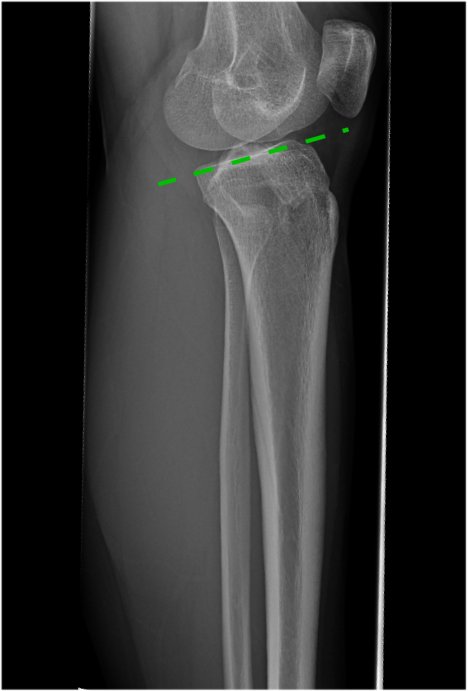
Posterior tibial slope
This shows a tibia with increased slope (>12 degrees), also known as increased posterior tibial slope. The tibia will tend to slide forward in relation to the femur. This means that there is an increased load on the anterior cruciate ligament and therefore the anterior cruciate ligament reconstruction she had previously had also ruptured.

Posterior tibial slope correction
Here is a side view of a knee, before and after surgery. A tibial osteotomy was performed to correct posterior tibial slope and 3 times revision cruciate ligament. This patient had undergone ACL reconstruction twice before, but unfortunately it was quickly resolved. This is because the femur slipped forward in relation to the tibia due to the steep slope of the tibia. After the inclination was corrected, it is likely that the third cruciate ligament reconstruction will last a lifetime.
Experience has shown that many of those who undergo surgery for increased tibial slope don’t actually need a second ACL surgery as they feel their knee has become stable following the osteotomy.
Video of a patient who has undergone repair of a torn ACL – called a primary ACL repair. The video shows that the ACL has healed and the patient feels healthy and stable and has resumed sports. In English ACL primary repair. I have performed about 50 of these surgeries and all patients have become stable except two.
Bone adhesion tear for cruciate ligaments
You may be unfortunate enough to suffer an ACL injury, where the bone attachment of the ACL to the tibia ruptures. It’s called an eminentia fracture. This means that the cruciate ligament is not attached to the tibia and should be reattached surgically. This is not an emergency surgery as many fractures usually are. However, the bone block should be stapled within the first 6 weeks. The surgery is an arthroscopic operation where strong threads pull the bone block down into place.


Every year, 3-4000 Danes suffer an ACL injury. Most injuries occur during sports, especially soccer, handball and skiing. ACL injuries occur when the knee is twisted too much.

Typically, the ACL is damaged when changing direction too quickly, during a feint, or when landing after a jump. Another common cause is skiing where the binding doesn’t release.
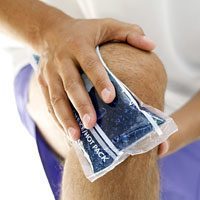
In the hours after the injury, the knee often swells up.
{ “@context”: “https://schema.org”, “@type”: “MedicalCondition”, “name”: “Cruciate Ligament Injury (ACL Injury)”, “alternateName”: “Anterior cruciate ligament injury”, “medicalSpecialty”: “Orthopedics”, “url”: “https://larsblond.com/korsbandsskade”, “description”: “Information about symptoms, diagnosis, and treatment of anterior cruciate ligament injury, including ACL reconstruction and primary cruciate ligament repair.”, “possibleTreatment”: [ { “@type”: “MedicalProcedure”, “name”: “ACL reconstruction” }, { “@type”: “MedicalProcedure”, “name”: “Primary cruciate ligament repair” } ], “signOrSymptom”: [ “Popping sensation in the knee”, “Swelling”, “Instability”, “Pain during weight-bearing” ]}


