
Hyperpressure

An elevated kneecap is also known as patella alta
Patella alta and patellofemoral pain.
If your kneecap sits too high, it can cause you to develop patellofemoral pain or a loose kneecap. When the kneecap sits too high, there is not enough overlap between your kneecap and the groove (trochlea) that the kneecap should ride in when the leg bends. On the back of the kneecap is a thick layer of cartilage, in fact the thickest layer in the body. The cartilage behind the kneecap is supposed to run against the cartilage in the guide furrow. This ensures that the kneecap runs smoothly when bending the leg, for example when climbing stairs. Very high forces are transferred between the large thigh muscle and the shin bone. If the pressure is not on the kneecap but instead on the large fatty pad (Corpus Hoffa), it causes the fat pad to overload. The fat pad is filled with nerves and when overloaded, inflammation occurs. Inflammation hurts. Some call it fat pad entrapment or Hoffa impingement.

Hoffa Impingement
The image to the left shows an MRI scan of a knee from the side. Cartilage is the gray stuff that sits behind the kneecap and is also seen on the surface of the femur bone. It is noticeable that the kneecap sits high and there is a small overlap between the cartilage of the kneecap and the femur. The patellar tendon is almost black and runs from the kneecap down to the tibia where it attaches. Note that behind the patellar tendon lies the large triangular Hoffa fat body. At the top of the fat pad you will see an almost white area and this is due to inflammation in the fat pad, also known as Hoffa impingement.
Cartilage damage to the kneecap can be a result of patella alta
When the kneecap sits too high, the overlap between the cartilage on the kneecap and the guide furrow is too small. This puts a lot of pressure on the lower part of the kneecap cartilage and can lead to cartilage damage. It is also called chondromalacia patella and means diseased cartilage behind the kneecap. It’s a known fact that patella alta predisposes to osteoarthritis of the kneecap joint due to cartilage overload.
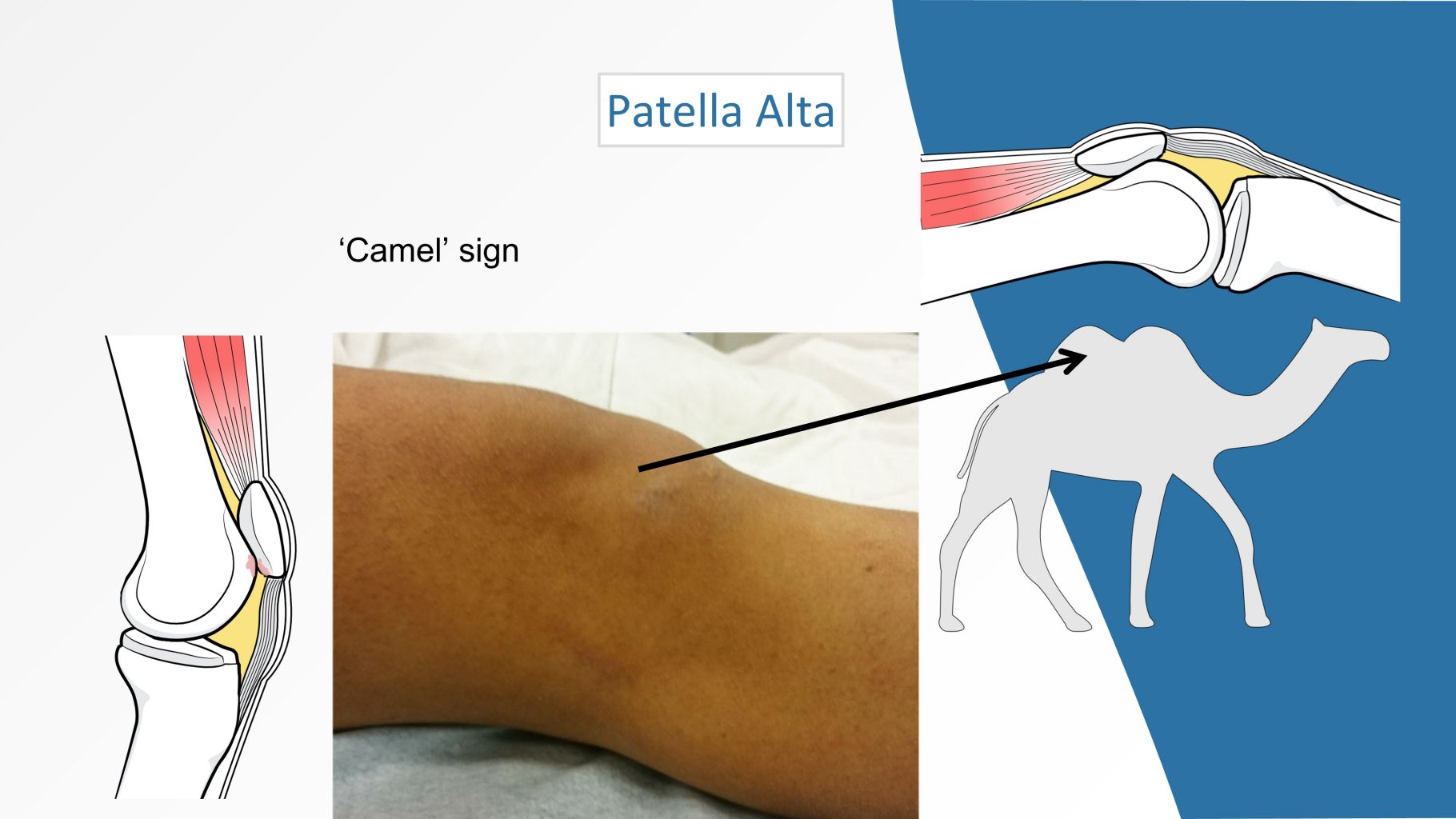
Camel knee
If the kneecap is too high, it can often be characterized by the kneecap bulging up and then there is another bulge where the fat pad is located. The two dents have given it the nickname camel knee as it looks like 2 humps.
Patella alta and loose kneecap
Having patella alta can predispose to kneecap dislocation and is the second most common cause of patella instability. Because the kneecap sits so high, the kneecap may not hit the guide groove of the kneecap properly when bending the knee. Instead, the kneecap extends to the outside, causing it to dislocate and sometimes even partially dislocate. A very unpleasant sensation and today we know that having a persistent patella instabiity actually impairs quality of life more than having an ACL injury.

As mentioned above, too high a kneecap can cause patellofemoral pain. You can read more about having patellofemoral or anterior knee pain here. Typically, patellofemoral pain is treated with physiotherapeutic exercise, but when the pain is caused by an overload of the fat body, the pain will often worsen and rest is a better solution.
Many people know that high-heeled shoes can leave marks on the floor because of the pressure on the heel. The same goes for cartilage, if there is too much pressure on a small area, the cartilage can’t take it.

This is the knee from the front. The yellow area illustrates the small area of overlap between the cartilage of the kneecap and the cartilage of the guide furrow. If there is less than 10 mm overlap, it can cause pain.
The cause of patella alta is unknown, but it is believed to be congenital.
Patientinformation folder senehæfte flytning – nr 12
The treatment for a high kneecap
It sounds very simple: when the kneecap is too high, it should “just” be moved downwards. However, it takes some knowledge and experience not to move the kneecap too much or too little. If it is moved too far down, a condition called patella baja develops, which means the kneecap is too low and causes a lot of pain and the knee cannot bend normally. Below you can read about relocating the patellar tendon attachment. Today, this is probably the most common surgery I perform for anterior knee pain and the results are very good,
Relocation of patellar tendon attachment because the kneecap is too high riding
If the kneecap is too high in relation to the groove (called patella alta), this surgery can pull the kneecap down into place in the groove (called a tuberosity tibia distalization – dTTO). The surgeon can see on an MRI scan whether the overlap between the cartilage of the kneecap and the cartilage of the groove is in sufficient. If the kneecap sits too high, the overlap is too small (6 mm or less).

The titanium screws are inserted at different angles to secure the patellar tendon attachment to the tibia after it has been displaced downwards due to an elevated patella.

Distalization of the tuberosity of the tibia (TTO distalization) which brings the kneecap down into the groove. The kneecaps attachment (Tibial tubercle) is moved downwards and fixed with 4 thin titanium screws. Called a tibial tubercle ostetomy – TTO

Here is a link to Youtube concerning the discussion between Hoffa Impingingement and jumpers knee and patella alta – klik her
Complications of patellar tendon relocation
Unfortunately, not everyone that achived a good result from this type of surgery. If you have had surgery for a loose kneecap, some people unfortunately find that the kneecap remains loose. For those who undergo surgery for anterior knee pain, not everyone recovers, although the success rate is quite high for those who have the patellar tendon attachment moved downwards due to a high patella. Unfortunately, complications occur in a few percent of cases. There may be pain and numbness over the operated patellar tendon attachment, in some people the bone block does not heal and some develop infection (though I have never had the latter complication). Some people experience sensory disturbances across the patellar tendon attachment and some experience discomfort when kneeling – however, this is very rare if 4 small-headed screws are used instead of 2 large-headed screws.


