
Arthroscopic Deepening Trochleoplasty for Trochlear Dysplasia and Patellar Instability
Arthroscopic Deepening Trochleoplasty for Trochlear Dysplasia
Arthroscopic deepening trochleoplasty is a minimally invasive surgical technique designed to correct trochlear dysplasia and restore normal patellofemoral stability. The procedure anatomically reshapes the trochlear groove while preserving cartilage, reducing pain, improving patellar tracking, and preventing recurrent dislocations.
This page provides a concise overview of indications, surgical steps, recovery, scientific evidence, and the advantages of the arthroscopic technique compared to traditional open trochleoplasty—which is particularly relevant for international patients seeking specialized treatment.
What is arthroscopic trochleoplasty?
Trochlear dysplasia is a structural abnormality in which the trochlear groove is too shallow or flat, causing the patella to slip out of place. Arthroscopic deepening trochleoplasty corrects this by reshaping the groove through keyhole incisions, allowing for precise anatomical reconstruction with minimal soft-tissue trauma.
The technique is based on:
- full arthroscopic visualization,
- controlled deepening of the groove,
- preservation of cartilage,
- stable fixation of the osteochondral flap.
This surgery creates a new, deeper groove to correct your anatomy if you have trochlear dysplasia. If you simply want to know why there are clear benefits to having the procedure performed using the arthroscopic technique, skip down to “Why Choose Arthroscopic Trochleoplasty?”
Who Is a Candidate for the Procedure?
Arthroscopic trochleoplasty is indicated for patients with:
- recurrent patellar instability,
- high-grade trochlear dysplasia (low lateral inclination angle),
- failed previous stabilization surgery (e.g., MPFL reconstruction),
- pain caused by improper tracking,
- instability during sports or daily activities.
It is particularly beneficial for young, active patients who need a quick recovery and minimal scarring. However, it is also advantageous for older patients, and I have operated on several patients around 50 years old, with the oldest being 58 years old.
International Patients
International patients from Europe, the UK, the Middle East, and the U.S. frequently travel to undergo this procedure. Quick recovery, minimal scarring, and expert surgical care.

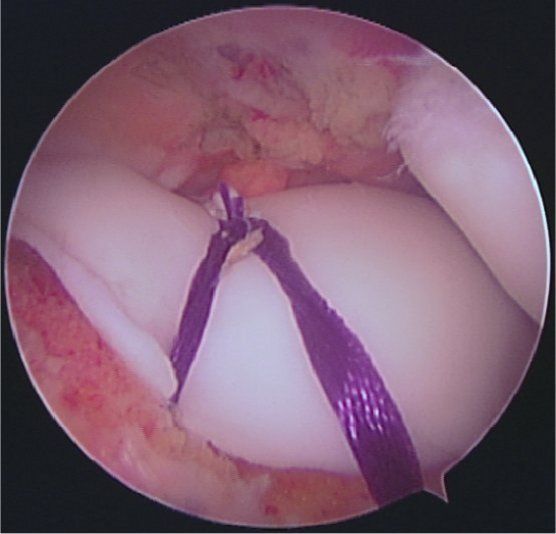
Illustration showing the new trochlear groove and the sutures holding the cartilage in place after arthroscopic trochleoplasty
Advantages Compared to Open Trochleoplasty
Arthroscopic deepening trochleoplasty offers several advantages:
- Minimally invasive (small incisions, no large incision)
- Less postoperative pain
- Faster rehabilitation
- More precise groove shaping
- Improved visualization of cartilage and anatomy
- Lower risk of stiffness
- Superior cosmetic results
- Reduced soft-tissue disruption
- Reduced heating of the cartilage flap.
- Reduced heating means a lower risk of damage to cartilage cells.
Many patients return to their normal activities much faster than after open surgery.
Surgical Technique (Step-by-Step)
The procedure includes:
- Arthroscopic Assessment of Trochlear Dysplasia and Patellar Tracking.
- Creation of an osteochondral flap while preserving the integrity of the cartilage.
- Deepening of the trochlear groove to its correct anatomical shape.
- Repositioning and fixation of the flap using bioabsorbable sutures and anchors.
- Verification of patellar tracking throughout the range of motion.
- MPFL reconstruction.
The technique restores normal trochlear geometry and eliminates the mechanical cause of instability.
Recovery and Rehabilitation
- Most patients experience:
- immediate improvement in patellar stability,
- less pain compared to open surgery,
- rapid return of motion.
- Typical recovery timeline:
- Weeks 1–2: walking with full weight-bearing and a full range of motion
- Weeks 4–6: Return of full range of motion
- Month 3: light exercise
- Month 6: Full athletic activity is permitted if possible
- Rehabilitation is tailored to each patient based on the severity of the dysplasia and any additional procedures.
Scientific Evidence and Publications
- Arthroscopic deepening trochleoplasty is supported by multiple peer-reviewed studies demonstrating:
- significant improvement in stability,
- high patient satisfaction,
- low complication rates,
- Excellent anatomical correction.
- Selected publications:
- Blønd L. et al. Arthroscopic deepening trochleoplasty – clinical outcomes and technique development. Read more here
- ESSKA presentations and international surgical courses.
- Comparative studies showing reduced pain and faster recovery compared with open trochleoplasty.
Why Choose Arthroscopic Trochleoplasty?
- This technique is ideal for patients seeking:
- anatomical correction,
- minimal scarring,
- full recovery,
- reduced pain,
- long-term stability,
- preservation of cartilage.
- reduced risk of arthrofibrosis
- It is one of the most advanced treatments available for trochlear dysplasia.
About the Surgeon
Lars Blønd, MD, Orthopedic Surgeon – Patellofemoral Specialist, International instructor in arthroscopic trochleoplasty techniques. Developed minimally invasive arthroscopic trochlear deepening techniques in 2007. Has performed a large number of arthroscopic trochleoplasty procedures, not only in Denmark but also in many other countries. Author of multiple peer-reviewed publications. Speaker at ESSKA, ISAKOS, and international courses. Also author of the chapter on patellar instability in the latest European textbook published by ESSKA on arthroscopic treatments.
Contact and International Patients
Patients from Europe, the UK, and other countries often travel to undergo this procedure. For a consultation or referral, please contact the clinic directly.
Or send it directly to my email address: lars. [email protected]
Zoom in
In case you would like a second opinion regarding your MRI or just your general knee situation, I do Zoom consultations. The cost is 225 euro.
History
I used to perform open trochleoplasty. In 2007, I developed the arthroscopic technique. I began performing the first arthroscopic deepening trochleoplasty procedures in 2008. The open trochleoplasty method leaves a larger scar; furthermore, it is more painful, and the risk of scar-related arthrofibrosis is 30%. The complication rate following this arthroscopic procedure is very low. In recent years, studies by other international groups have adopted the arthroscopic deepening trochleoplasty technique. They report results comparable to those of our three previous publications. To date, I have operated on patients from 15 different countries:
More about the groove surgery
By using the pinhole technique (arthroscopic), the surgery is less traumatic for your knee, and rehabilitation is likely to be faster. It is worth noting that the groove procedure is usually performed in conjunction with a reconstruction of the medial patellofemoral ligament (MPFL reconstruction). Even the most severe cases of trochlear dysplasia can be treated with arthroscopic deepening trochleoplasty.
Heating of cartilage flap
When performing open trochleoplasty, you need to debride the bone on the posterior side of the cartilage flap using a high-speed burr, which may cause heating. Heating may impair the viability of the cartilage. During arthroscopic trochleoplasty, a constant, high volume of water flow ensures that no heating occurs.
Why perform MPFL reconstruction as well?
Why isn’t groove surgery enough? And why should you also have the MPFL reconstructed? (medial patellofemoral ligament = the inner ligament of the kneecap). First of all, this is because the MPFL is always torn when the kneecap dislocates. In most cases, it does not heal on its own and therefore must be reconstructed. Furthermore, the trochlear groove does not provide stability to your kneecap until the kneecap reaches the trochlea. Importantly, this first occurs after your knee is bent about 20 degrees. This means that the MPFL is necessary to provide stability to the kneecap from a fully extended knee position until the kneecap reaches the new groove at a 20-degree bend. There is scientific evidence to support this. Read more about MPFL reconstruction here
Arthroscopic trochleoplasty and no MPFL reconstruction.
If your problem is chronic anterior knee pain caused by a groove that is too shallow, and your kneecap is stable, then you do not need to have the ligament that stabilizes the kneecap reconstructed—for more information, see the page on anterior knee pain.
In some situations, there is a combination of trochlear dysplasia and increased femoral anteversion and/or increased external tibial torsion (Kissing Knees) , and this must be investigated further; otherwise, there is a risk that the outcome of arthroscopic trochleoplasty will be suboptimal.
After surgery
You are allowed to bear your full weight and move your limb freely immediately after your surgery. No brace will be applied, but you will need crutches for approximately 3 weeks. You will only stay in the hospital for approximately six hours. Some patients have traveled 2,000 km back home right after surgery. Patients from Europe typically fly back three days after surgery, and patients from the U.S. return after a week. Most patients begin physical therapy within 3 to 10 days after surgery. Some might find this rehabilitation regimen a little daunting, but it has proven effective for more than ten years without any problems.
Science
I have published the following peer-reviewed scientific papers. In addition, I have contributed to several papers on trochlear dysplasia and authored the one and only book on the topic.
- 1. Blønd L. and Schöttle P. The arthroscopic deepening trochleoplasty. PDF Version
- 2 Blønd L., & Haugegaard M. Combined arthroscopic deepening trochleoplasty and reconstruction of the medial patellofemoral ligament for patients with recurrent patella dislocation and trochlear dysplasia. PDF Version
- 3. Blønd L. Arthroscopic deepening trochleoplasty—The technique. PDF Version
- 4. Blønd L. Arthroscopic deepening trochleoplasty for chronic anterior knee pain after previous failed conservative and arthroscopic treatment. Report of two cases. PDF version
- 5. Blønd L, Barfod KW. Trochlear Shape and Patient-Reported Outcomes After Arthroscopic Deepening Trochleoplasty and Medial Patellofemoral Ligament Reconstruction: A Retrospective Cohort Study Including MRI Assessments of the Trochlear Groove. PDF version
Frequently Asked Questions (FAQ)
How severe is my trochlear dysplasia?
This is a common question, and it is usually explained during an online consultation.
Is surgery required? Or are there any conservative treatment options left?
This is typically discussed in an online meeting.
How long does the surgery take?
The procedure typically lasts between 1.5 and 2.5 hours.
When is full weight-bearing allowed?
From day one, using crutches to help maintain balance.
When can I fly back home?
This depends on the distance. Most European patients fly home after 3 days, and patients from the U.S. usually return after about a week. A seat that allows you to straighten your leg may be necessary.
Do I need crutches?
Yes. Crutches are normally used for 2–4 weeks, depending on how quickly each person recovers.
Do I need a brace after surgery?
No brace is required. Full weight-bearing and full range of motion are permitted immediately.
Should I try a less invasive procedure first?
No. If trochlear dysplasia is the underlying cause, a single successful surgery is usually sufficient. Performing “smaller” procedures first often leads to repeated failures.
Is only one knee being operated on?
Yes. Only one knee is operated on at a time. About one-third of patients have dysplasia in both knees.
How long is the recovery?
The knee improves over the course of 1–2 years. Most patients feel fairly well after 3 months.
Why isn’t this procedure more widely used around the world?
Arthroscopic trochleoplasty is technically challenging and requires extensive arthroscopic experience. Many surgeons continue to use the open technique because it is familiar, not because it is better.
When can I go back to work or play sports?
Sedentary work is usually possible after about 4 weeks. Light exercise typically begins around 6 months.
Do I need antithrombotic medication?
Yes, if you are 30 years old or older.
Do I need a CPM machine?
No. You will begin doing active exercises on your own immediately after surgery.
Do I need physical therapy?
Yes. Rehabilitation is essential. Many international patients work with physical therapist Dorte Nielsen (Proalign.dk), who has extensive experience with trochleoplasty recovery.
Will I receive a postoperative plan?
Yes. You will receive a clear plan. Full weight-bearing and free movement are allowed, but crutches are needed for the first few weeks.
How long is the sick leave?
This depends on the type of work and how you commute from home to work or school. At least one week of leave is recommended.
Will my insurance cover the surgery?
In most cases, yes—including travel expenses. The procedure is often significantly less expensive than similar surgery in the U.S.
What is the cost of an online consultation and MRI evaluation?
225 euros. MRI scans can be sent via email, Dropbox, WeTransfer, or similar services.
What is the price for combined arthroscopic trochleoplasty and MPFL reconstruction?
Approximately 11,000 euros, including implants (the cost of the implants alone is about 2,000 euros), and that includes any follow-up visits.
How often do you see complications?
To my knowledge, there have been no deep infections to date (2026). One case of arthrofibrosis. One case of patellar redislocation due to increased femoral anteversion. Three cases of deep vein thrombosis, all in patients over 30 years of age.
How to Prevent Stiffness and Arthrofibrosis?
It is important to prevent stiffness by doing range-of-motion exercises starting on the first day after surgery.
What is the risk of the patella dislocating again after surgery?
One patient experienced a redislocation, and I have performed more than 300 surgeries. This was the ninth case at the start (2009). I failed to notice that the patient had severe femoral anteversion. Since then, there have been no redislocations.
Do I provide postoperative follow-up care for international patients?
Yes. Follow-up sessions can be conducted both in person and online, depending on your location and needs. I’m always interested in hearing how it goes!
Why Patients Travel to Denmark for Arthroscopic Trochleoplasty
Patients from Europe, the UK, the United States, and other countries often travel to Denmark for arthroscopic deepening trochleoplasty because the procedure is highly specialized and performed by only a few surgeons worldwide. Denmark offers a unique combination of surgical expertise, predictable outcomes, and a quick recovery.
Key reasons international patients choose Denmark:
- The minimally invasive arthroscopic deepening trochleoplasty technique preserves cartilage, reduces pain, and allows for faster rehabilitation compared to traditional open surgery.
- High surgical volume and experience: This technique has been performed for many years with consistent results, making Denmark one of the leading centers for the treatment of trochlear dysplasia.
- Accurate diagnosis and individualized treatment planning. A detailed MRI evaluation ensures that trochlear dysplasia, patellar tilt, patella alta, and rotational issues are correctly identified before surgery.
- Timeline for a Short Hospital Stay and Safe Travel: Most European patients return home after 3 days, and U.S. patients typically travel back after about a week.
- Clear postoperative instructions, full weight-bearing, a full range of motion, and structured physical therapy make recovery straightforward for international patients.
- Transparent pricing: Surgical costs are significantly lower than in many countries, and insurance often covers both the procedure and travel expenses.
Rehabilitation Protocol
After Arthroscopic Trochleoplasty and MPFL Reconstruction – by Dorte Nielsen

Dorte Nielsen Proalign.dk
Dorte Nielsen is the physiotherapist who have treated far most of my arthroscopic trochleoplasty patients for more than 10 years. She often also help patients from abroad. She can see you both before and after surgery and guide you. She can tell you when you train too little or to much and guide you if something is different from normal. Here is a link to her webpage.
Medical Disclaimer:
The information on this page is general in nature and cannot replace a personal consultation, physical examination, or MRI evaluation. Surgical decisions regarding trochlear dysplasia and patellar instability should always be based on an individual assessment by a qualified orthopedic surgeon. If you experience pain, instability, or knee symptoms, please seek medical advice.
Online meeting
If you have been diagnosed with trochlear dysplasia but are unsure of its severity, you are welcome to schedule an online consultation. The same applies if you are considering traveling to Denmark to have surgery performed by me. The cost for an online consultation is 225 euros. You must send me the MRI (DICOM files). Once I have received the MRI, we can schedule a time to meet online.
Author
Lars Blønd, M.D.
Orthopedic surgeon with international expertise in trochlear dysplasia. Author of the first scientific book on trochlear dysplasia. Developed and studied the arthroscopic trochleoplasty procedure. Also author of the chapter on patellar instability in the latest European textbook published by ESSKA on arthroscopic treatments.
Booking
Aleris Hospital Søborg
Gyngemose Parkvej 66, 2860 Søborg
Phone +45 38170700
Email [email protected]
Below is more information for the tech-savvy
Example of an “Arthroscopic Deepening Trochleoplasty”.

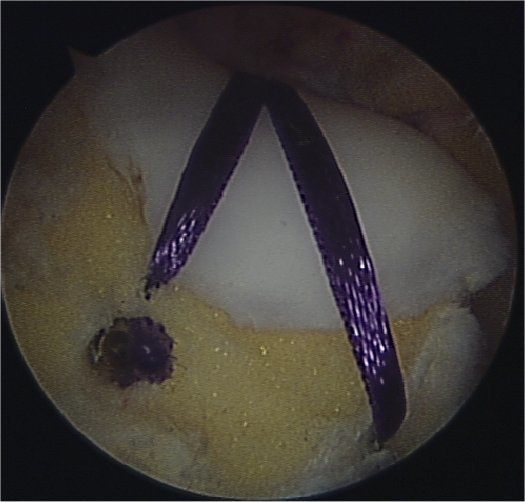
Before (left) and after (right). The blue band dissolves after 6 weeks and is therefore only temporary until the cartilage has healed.
MRI before (left) and after (right)

Trochlea before and after groove surgery

– “It is difficult to balance a tennis ball on a football”
Second look

Two different examples of what the inside of the knee looks like 3 months after groove surgery. As you can see, the cartilage has healed very well, and the blue bands/tapes have dissolved.
Second look – 3 years after

Pictures that illustrate the difference in scar formation between open and arthroscopic deepening trochleoplasty.

Nice small scars after combined arthroscopic trochleoplasty and MFPL reconstruction

Eight weeks after surgery, the scars will improve significantly over time. I recommend that you use tape during the first month after surgery, as this will reduce tension on the scars. This will help prevent the scars from widening.

Open trochleoplasty
My last open trochleoplasty
Video arthroscopic trochleoplasty
Kenneth doing well one year after
Video
Arthrex, the company that originally helped me develop the technique, has now also produced a video in 4K quality— watch it hereBe sure to read what some patients have to say on the testimonial page—or see this YouTube video titled “Trochleoplasty Gathering” (in Danish, but with English subtitles)
Why should I also have a groove surgery and not just MPFL reconstruction?
That is a good question and some surgeon argue that it is not necessary. Maybe it is not 100% necessary if you just want stability, but if you also want a knee without anterior knee pain, trochleoplasty have to be done. Also, sometimes I see patients having trochlear dysplasia and who have had an MPFL reconstruction only. Then after some years the kneecap starts to becomes loose again because the MPFL reconstruction get loose by time. Therefore if you visit a surgeons, who do not do trochleoplasty surgery, and you do have this flattened groove. Most importantly try to get a second opinion in case this surgeon tells you that the surgery is rare, dangerous and complicated surgery since this is not correct.
Case Study – Mikkel
Mikkel was the first patient to undergo arthroscopic trochleoplasty, back in March 2008. He had previously undergone unsuccessful surgery to stabilize his kneecap, and both his doctor and physical therapist had told him he would never be able to play sports again. Most notably, Mikkel had suffered from problems in both knees since he was 8 years old and had never been able to run. Finally, at the age of 29, he underwent surgery on both knees using the groove technique. That meant 21 years without running.
Follow-up on Mikkel
Today is Mikkel doing well in his knees and he is running and playing soccer. He claims that the only annoyance is the sound from the knees, when he climbs stairs. Go to YouTube and listen to his and other stories during the trochleoplasty gathering in 2014. Many thanks to Asker Blønd – my son – who created this video. Click here trochleoplasty gathering.or check this video
Outcome after trochleoplasty
In general, the outcomes following groove surgery are very good, with fewer than 2 percent of patients experiencing new dislocations. As a result, quality of life improves dramatically. I have been following all my arthroscopic trochleoplasty patients for more than 18 years now, and on average, there have been improvements in all measured parameters and a high level of satisfaction. Both the technique and the results of this procedure have been published in peer-reviewed journals. To date, I have presented the “Arthroscopic Deepening Trochleoplasty” technique in the United States, Japan, the Netherlands, the United Kingdom, Sweden, Norway, Poland, Germany, Austria, Portugal, and China. Furthermore, the procedure has been adopted by other surgeons and is now performed in fifteen different countries worldwide.
Tibial Tubercle Osteotomy =TTO
What about having a TT osteotomy instead of a groove surgery? There are several studies indicating that the groove surgery gives better results – read more here. We know that trochleoplasty surgery normalize the anatomy. Moreover, we do know that patients, who have had TT surgery after a decade are having declining results. The first trochleoplasty patients I operated more than 19 years ago are still doing fine. So based on this and my clinical experience by doing both many tibial tubercle osteotomies an trochleoplasty surgeries, I strongly recommend to you to undergo trochleoplasty if you have trochlear dysplasia. Unfortunately, many orthopedic surgeons argue, that they do not perform trochleoplasty and therefore they recommend TTO, but instead they must refer you to someone who do trochleoplasty, and preferable the arthroscopic trochleoplasty.
Here is the latest paper on arthroscopic deepening trochleoplasty here or simply go the page where you can find all my scientific papers
LinkedIn 2023
Photo library with some examples of arthrocopic trochleoplasty




 [tcb-script type=”application/ld+json”]{ … MedicalProcedure schema … }[/tcb-script][tcb-script type=”application/ld+json”]{ … FAQ schema … }[/tcb-script]


